
If your company has an iPhone app with a "Log in with WeChat" button, a WeChat Pay option at checkout or a "Share to WeChat" link, this one is worth five minutes of your developer's time. Nothing has broken yet. It could, though, the next time your app is rebuilt, and probably without anyone noticing straight away.
What WeChat announced
On 22 October the WeChat Open Platform team posted an adaptation notice in its developer docs about Xcode 27 and iOS 27. The short version is that Apple has tightened a limit that most people outside an iOS team have never heard of.
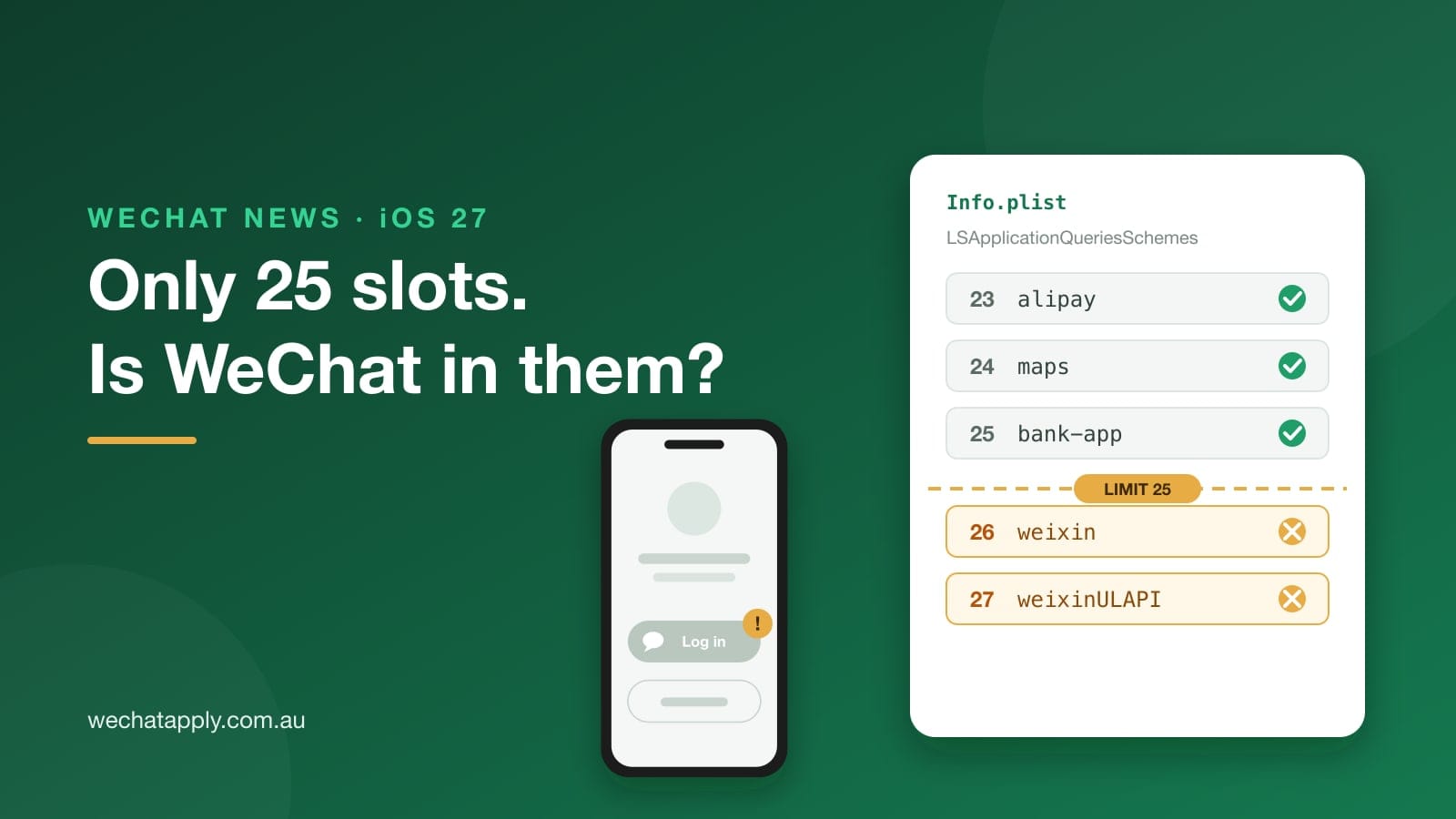
iPhone apps have a list in their configuration called LSApplicationQueriesSchemes. It's where an app declares which other apps it wants to check for, so it can ask iOS "is WeChat installed on this phone?" Since iOS 15 that list has been capped at 50 entries. According to WeChat's notice, and Apple's own documentation backs this up, apps built with Xcode 27 and running on iOS 27 will only have the first 25 entries honoured. Anything after number 25 gets ignored.
WeChat's own SDK (the OpenSDK, which handles login, sharing, payments and opening Mini Programs from an app) depends on a few of those entries. If they sit below position 25, the check fails. Your app may then decide WeChat isn't installed when it is, or that it doesn't support a feature it actually does. WeChat specifically lists login, sharing, payment and launching Mini Programs as the things that can go wrong.
Who is affected, and who isn't
The notice is quite precise about this, which we appreciated. All three of these combinations keep the old 50-entry limit:
- an app built with Xcode 26, running on iOS 26 or iOS 27
- an app built with Xcode 27, running on iOS 26
Only the combination of building with Xcode 27 and running on iOS 27 brings in the 25-entry cap. Apple released iOS 27 in mid-September, so a growing share of your Chinese-speaking iPhone users will already be on it. The trigger, then, is really your next build. The day your team (or your agency) upgrades Xcode and pushes an update, the new rule applies.
So an app that works perfectly today can stop handling WeChat login after a routine update that had nothing to do with WeChat. That's the bit we'd worry about.
Which entries matter
WeChat lists five schemes. Two are mandatory: weixin and weixinULAPI. Without them, the SDK's registerApp call returns NO and nothing WeChat-related works. A third, weixinURLParamsAPI, is "strongly recommended". Without it, the SDK falls back to passing data through the clipboard, which WeChat says can affect sharing and opening Mini Programs. The last two, weixinStateAPI (sharing to WeChat Status) and weixinQRCodePayAPI (opening WeChat Pay from a QR code), are only needed if you use those features.
The catch
Twenty-five sounds like plenty until you look at a real app. Apps that sell to Chinese visitors or students tend to check for a lot of other apps: Alipay, maps apps, other social platforms, banking apps, sometimes a dozen entries added by third-party SDKs that nobody on the current team remembers installing. Cross-platform frameworks such as React Native and Flutter often add entries through plugins at build time, so the list in your source code may not match what actually ships.
That's why WeChat asks developers to check the final release build, not just the project file. It's also why it tells people not to trim the WeChat entries to save room. The fix is to reorder the list so the WeChat entries (and anything else you really need) sit in the top 25, and then to test the WeChat features on a physical iPhone running iOS 27. A simulator check on its own won't cut it here.
There's a longer-term signal too. IT之家 notes that Apple now marks the canOpenURL check itself as deprecated as of iOS 27. We haven't seen Apple say what replaces it for this use, so we wouldn't panic, but it does suggest this list will only get stricter. Universal Links, which WeChat has supported for years, are the more future-proof route.
What it means for overseas businesses
Most of the Australian businesses we work with reach Chinese customers through an Official Account or a Mini Program, and if that's you, this notice doesn't touch you at all. Mini Programs run inside WeChat, so there's no iOS allowlist involved.
It matters if you also have your own native app with WeChat built in. Think retail and duty-free apps with WeChat Pay, education apps with WeChat login for Chinese students, or travel apps that let people share bookings to WeChat. The work itself is small, usually a reordered list and an afternoon of testing. The risk is that nobody does it because nobody knows to, and the first you hear about it is a drop in WeChat sign-ins.
Our honest take is that this is a good excuse to ask whether your native app needs to handle WeChat features at all. For plenty of brands, a Mini Program does the China-facing job with less upkeep, because Tencent rather than Apple controls the environment.
If you're not sure how your app is set up, or you'd like a second opinion on whether a Mini Program would serve your Chinese customers better, get in touch and we'll take a look.
Sources: WeChat Open Platform, Adaptation notice on WeChat OpenSDK for Xcode 27 and iOS 27 (22 October 2026); Apple Developer Documentation, canOpenURL(_:); IT之家, WeChat issues OpenSDK adaptation reminder for Xcode 27 and iOS 27 (22 October 2026).